
Bei - Rental Companion
Supporting Remote Workers’ Housing Decisions
Personal Project
Challenge behind Remote Work Housing
Remote Work Transformed Home into a Multi-Functional Space That Must Support Both Living and Working
On Chinese social media, I came across a post that seemed to capture the dream of remote work: a young woman in her lounge wear, sunlight streaming through her window as she worked at her computer. But the posts that followed revealed a different reality — uncertainty about where to live, the tension between rent and lifestyle, and the quiet exhaustion of those whose homes had become their offices.

Rednote Posts Shared by Remote Workers (Translated)
These stories reflect a broader shift. In China, the rise of the internet economy has made remote work common, redefining what “home” must support. It is no longer just a place for rest, but one that fosters productivity, focus, and well-being, a transformation accelerated by the pandemic.

Number of Online Office Users in China (CNNIC, 2020–2024)
Research Question & Method
How Do Remote Workers Live and Work? Do They Have Any Problems Renting Housing?
I conducted interviews with 7 full-time remote workers, including a lawyer, illustrator, advertising professional, and freelancer, via Rednote, one of the Chinese social media. In parallel, I collected and analyzed 25 Rednote posts describing remote work life and housing needs to identify recurring patterns and challenges.
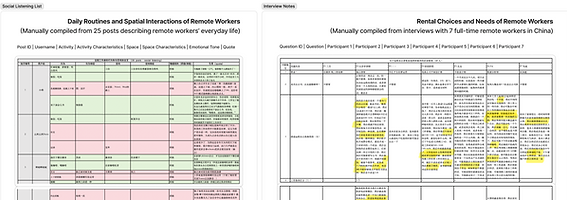
Tables of Interview and Social Listening Results (Partial)
Research Finding I
Three Challenges in Living a Remote Working Life
Remote workers’ daily routines reveal various challenges:
1. Sustaining high demand of efforts can be especially significant, because their performance is frequently tied to measurable output, Their productivity heavily depends on living conditions such as internet speed, quiet surroundings, and clearly-defined work zones.
2. Blurred boundaries between work and personal life make it difficult to either focus or unwind, underscoring the need for distinct boundaries between professional and private time.
3. Social isolation stands out as a persistent concern. Many remote workers find it hard to maintain in-person interactions, as few environmental or social cues prompt offline connection. This lack of spontaneous engagement not only deepens feelings of isolation but also disrupts work–life balance and diminishes overall satisfaction with the home environment.

Common Needs of Remote Workers

Diagram of Daily Routines of Remote Workers
Research Finding II
Remote Workers’ Housing Pathways and Challenges
The housing search for remote workers often starts the same way, endless scrolling through online listings, followed by inevitable in-person tours.
Remote workers’ rental experiences reveal various challenges:
-
Yet the services and tools they rely on share common flaws: unreliable or incomplete information, and issues that only emerge after moving in.
-
For remote workers less tied to office proximity, online listing sites such as Beike — despite extensive listings and polished systems — can introduce an unexpected challenge: decision paralysis. Faced with numerous suitable options, many struggle to make confident choices, and even widely used platforms can reinforce this sense of overwhelm through sheer volume.

Ecosystem Map: Remote Workers’ Housing Pathways & Challenges
Design Opportunity
How Might We Help Remote Workers Find Rental Housing That Enhances Productivity, Social Connection, and Work–Life Balance?
Design Opportunity
How might we help remote workers find rental housing that meet their needs to make they work more productive, live more connected, and have a balanced work and life?
Ideation
An AI Agent Leveraging Online Listing Platforms to Assist Remote Workers in Making Informed Housing Decisions
Based on research, remote workers often rely on online listing sites for rentals. In both posts and interviews, Beike, one of China’s largest platforms, was frequently mentioned. Accordingly, the AI agent integrates with Beike via a website plugin, leveraging its extensive listings and comprehensive information.

Scenario 1: Jason Defines His Housing Preferences
Setup: Jason learns from a friend that there is an AI Agent that can help analyze housing listings to find the most suitable home. He opens the website link on his laptop to start.
Conversational Survey
Conversational Survey


Swipe right to see more →
Scenario 2: Jason Shortlists and Selects Properties
Setup: On Beike’s desktop web platform, Jason favorites a lot of potential listings by skimming through the descriptions. Now he is ready to pick a handful to visit.
AI Rating & Ranking


Swipe right to see more →
Scenario 3: Jason Visits, Compares, and Finalizes a Rental
Setup: Today is the day for Jason to tour his top picks. He opens the mobile web link on-site and begins visiting the first shortlisted property.
Guided Tour


Swipe right to see more →
Start with Prompt
Validate the Prompt and Understand Patterns in AI-Generated Content

Role Prompt
Based on the Research Findings
I brainstormed with ChatGPT-5, which, based on previous research findings, role-played the AI agent Bei to evaluate, analyze, and visualize the provided housing information.

Generate Scores
for Each Aspect
Compare and Suggest
Based on Needs
Visualize Data and
Generate Charts
Infer and Create
Analytical Diagrams
Chat Records with ChatGPT-5
-
ChatGPT-5 can perform the envisioned Agent tasks, extending unexpectedly beyond analyzing text and generating basic charts.
Evaluation
Wireframe Prototype Testing With Remote Workers via Online Video Call
Before building the high-fidelity version, the wireframe was tested as a prototype with two remote workers via online video calls who had participated in the earlier interviews. I guided the sessions and operated the interface while sharing my screen, as participants described what actions they wanted to take.
Evaluation Finding
Challenges related to the blank canvas problem, trust issue, and limited crowdsourced collection need to be addressed.

To address the Blank Canvas Problem, the workflow has been adjusted from the wireframe sequence:
-
Users first review and categorize the common needs provided by the system, which helps expand their thinking and inspires them to propose their own needs in the next step.
-
During the stage where users add their own needs, both Must-Have and Nice-to-Have Needs are presented simultaneously, making it easier for users to distinguish between the two categories and greatly reducing misclassification.

Scenario 1: Enhancements from Wireframe to High-Fidelity

To address the trust issue, the workflow has been adjusted from the wireframe sequence:
-
This section elaborates on the criteria and reasoning behind the property’s ratings in work efficiency, work-life balance, and social connection, helping users better understand, trust, and apply these reference indicators in their decision-making process.
-
The section also explicitly labels AI-generated secondary analyses, including analytical diagrams and inferred insights, and provides links to the original source materials for users to verify and trace the information.

Scenario 2: Enhancements from Wireframe to High-Fidelity

To address the limited crowdsourced collection, the workflow has been adjusted from the wireframe sequence:
-
The sharing permission prompt now appears immediately after users save their first review, rather than after finalizing their rental decision on the “Congrats” page. This change prevents data loss caused by users exiting early before granting permission.
-
To alleviate privacy concerns, one of the main reasons users hesitated to share, the system now automatically blurs or hides any personal information in both text and photos, and clearly informs users of this protection in the prompt.

Scenario 3: Enhancements from Wireframe to High-Fidelity
High-Fidelity I
Scenario 1 – Defining Preferences
High-Fidelity II
Scenario 2 – Shortening Lists
High-Fidelity III
Scenario 3 – Visiting and Finalizing a Rental